In the Montessori world, you may hear teachers talk about “planes of development” and wonder what that means for your child. Simply put, Dr. Maria Montessori observed that children grow and learn in predictable stages, each with its own needs, strengths, and ways of understanding the world.
The first plane of development, which spans from birth to age 6, is one of the most important periods in a child’s life. During these early years, children build the foundation for learning, behavior, relationships, and emotional health.
–
What Are the Montessori Planes of Development?
Dr. Montessori identified four major stages of human development, which she called planes of development. Each plane lasts about six years and has its own characteristics.
The four planes are:
Birth to age 6 – Early Childhood
Ages 6 to 12 – Childhood
Ages 12 to 18 – Adolescence
Ages 18 to 24 – Maturity
Each stage builds on the one before it. When children receive the right support in early childhood, they are better prepared for future academic and social success. The first plane, from birth to age 6, is often described as the foundation of all learning.
The First Plane of Development: The Absorbent Mind
Dr. Montessori referred to children in the first plane as having an “absorbent mind.” This means young children naturally take in information from their environment without conscious effort.
They are constantly learning from:
Language they hear
Routines they observe
Social interactions
Cultural norms
Physical surroundings
Unlike older children, they do not need formal instruction to learn. They absorb what is around them simply by living in it. This is why early environments are so important at this stage. In Montessori, this is called the prepared environment.
A prepared environment includes:
Child-sized furniture
Accessible materials
Orderly shelves
Natural light and calm colors
Real tools and materials
Clear routines
Everything is placed intentionally to support independence and focus. This environment allows them to choose meaningful work, complete it independently, and return it when finished.
Two Phases Within the First Plane
The first plane is divided into two important phases. Understanding these helps explain why Montessori programs group ages 3 to 6 together.
Birth to Age 3: Unconscious Absorption
From birth to around age 3, children learn primarily through unconscious absorption. They are building basic skills without realizing it.
During this phase, children develop:
Movement and coordination
Spoken language
Emotional attachment
Trust in caregivers
Basic social awareness
Learning happens through sensory experiences, repetition, and close relationships.
Ages 3 to 6: Conscious Learning and Independence
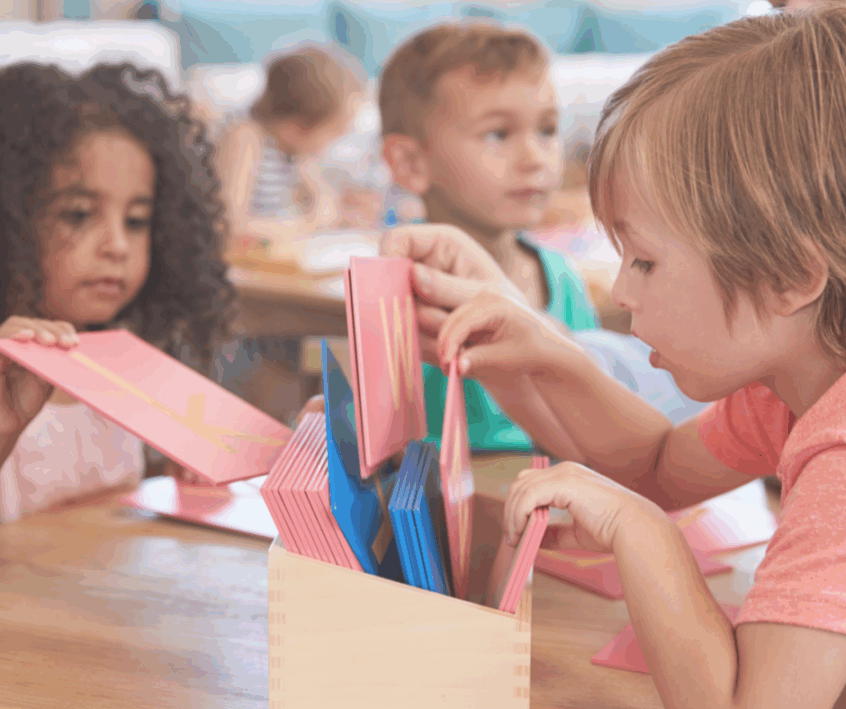
From ages 3 to 6, children move into a more conscious phase of learning. They still absorb information easily, but now they begin to seek it intentionally. This is the Primary age group in Montessori.
During this phase, children show strong interest in:
Doing things independently
Repeating activities
Following routines
Learning letters and numbers
Understanding social rules
Helping with real tasks
They want to master skills and feel capable. This is why Montessori classrooms for ages 3 to 6 are carefully prepared to support self-directed learning.
Sensitive Periods in the First Plane
Another key feature of the first plane is what Montessori called sensitive periods. These are windows of time when children are especially ready to learn certain skills. During sensitive periods, learning happens quickly and naturally.
Common sensitive periods from birth to age 6 include:
Language development
Order and routine
Movement and coordination
Sensory refinement
Social behavior
Interest in letters and numbers
For example, many children between ages 3 and 6 show intense interest in writing, sounds, and words. When supported properly, literacy develops with ease. Montessori classrooms are specifically designed to recognize and respond to these sensitive periods.
Learning Through Movement and Hands-On Experience
In the first plane, children do not learn best by sitting still and listening. They learn through movement and physical interaction with their environment. This is why Montessori classrooms encourage carrying materials, pouring and transferring, building and sorting, writing with hands-on tools, walking and balancing, and cleaning and caring for spaces. These activities are not “extras”. They are essential for brain development.
A common misconception of Montessori education in the Primary years is that children are not learning through simple practical life activities such as sweeping, doing dishes, wiping, etc, but research in neuroscience shows that movement and learning are closely connected in early childhood.
Academic Foundations in the First Plane
Although Montessori emphasizes hands-on learning, academics are an important part of the first plane. For children ages 3 to 6, academic learning begins with concrete experiences.
In language, children work with:
Phonetic sounds
Movable alphabets
Tracing letters
Storytelling
Vocabulary development
In math, children explore:
Quantity and number sense
Place value
Addition and subtraction
Measurement
Patterns
These concepts are introduced using physical materials before moving to abstract thinking. This leads to deep understanding rather than memorization.
What Research Says About Early Development
Modern child development research supports many of Montessori’s original observations. Studies show that early childhood environments that emphasize independence, hands-on learning, order and routine, language-rich interactions, and positive relationships lead to stronger executive function, academic readiness, and emotional regulation.
The first six years of life are when the brain forms most of its foundational neural connections. High-quality early education during this period has long-term benefits. Montessori was built on these principles long before modern neuroscience confirmed them.
Why the First Plane Matters for Lifelong Learning
The first plane of development shapes how children see themselves as learners. Children who are supported during this stage tend to develop confidence, curiosity, resilience, problem-solving skills, and positive attitudes toward school. When children believe they are capable, they approach future challenges with optimism rather than fear. This mindset often begins between ages 3 and 6.
–
The Montessori first plane of development is about much more than early academics. It is about building the whole child. From birth to age 6, children are forming the habits, skills, and attitudes that will guide them for the rest of their lives.
By respecting the absorbent mind, honoring sensitive periods, and preparing thoughtful environments, Montessori education supports children in reaching their full potential.
–
The best way to understand Montessori is to observe a classroom, ask questions, and see how children interact with their environment. If you are curious about Montessori education for preschool and kindergarten-aged children in northeast Indiana, you can schedule a tour with Southwest Montessori Academy here.
–
